By Nohe Garcia and Blue Evening Star
Trash collection technologies are devices installed in creeks, rivers, and storm drains to capture floating litter, plastic waste, and debris from stormwater runoff before it flows into larger bodies of water.
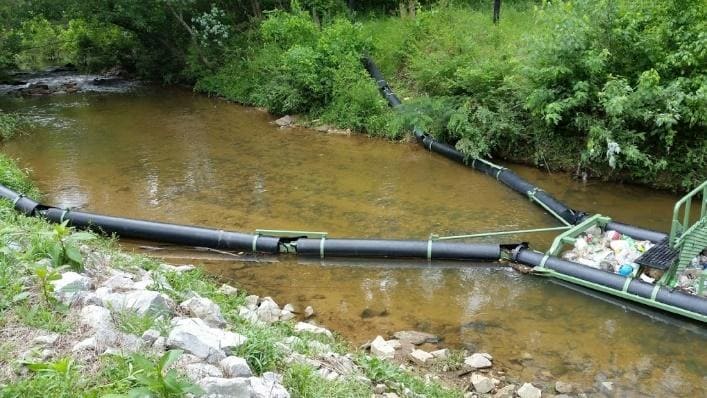
Catch basins for urban trash capture were first implemented in 1995 in New York City. Between 1995 and 1999, commercial mesh and net-based pollutant traps began being installed in locations in Australia and the United States. In December 1999 the U.S. EPA implemented Stormwater Phase II regulations, legally compelling municipalities to adopt Best Management Practices to filter trash and pollutants from stormwater runoff, leading to widespread commercial production of modern hooded catch basin devices and litter traps. Other trash trap technology includes litter booms, debris booms, Bandalong traps, trash wheels, solar trash wheels, skimmer boats, litter glitters, trash racks, debris screens, netting systems and netting trash traps.
FOSCR is looking into the feasibility of designing and installing trash collection technology in three locations on the Nogales Wash. The purpose would be to capture tons of trash that currently accompany storm events and thus to stop it from filtering along the Santa Cruz River for miles. Trash allowed to travel far away from the source (in this case the border at Nogales Wash) breaks down into small particles of micro-trash that seeps into drinking water.
Our downstream community trash pick-ups are not an efficient method of dealing with tons of trash that comes from the Nogales Wash into the Santa Cruz River riparian corridor. With proper trash traps placed in the right locations (gathering different sizes of trash in each location) we could alleviate the problem as close to the source as possible. Given the challenges of a river that crosses an international border, this is likely the best solution.
The Nogales Wash and Santa Cruz River fluctuate between being completely dry, gentle flows, and violent storm-driven floods. Trash trap designs for this region would have to consider this, or they will break apart during the surges. An option for the Nogales Wash might be a trash trap that can float with paddles, like the San Diego floating trash boom installed near the border there.
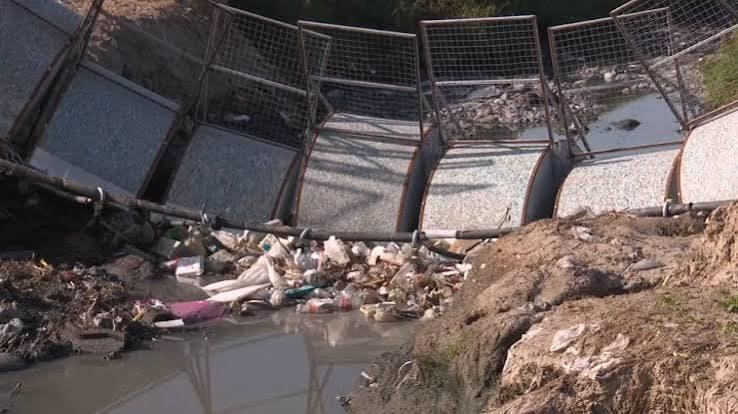
The conditions in the Tijuana River bed (just north/inside U.S. territory near the San Diego border) are similar to our river conditions. In San Diego, a 1,200-foot-long floating barrier with fence-like partitions managed by the binational environmental group Alter Terra adjusts dynamically with the river’s water level. The floating trash boom in the Tijuana River captures approximately 2,000 tons of plastic, tires, and debris over a two-year period, stopping heavy pollution from flowing into the Tijuana River Valley, San Diego-area beaches, and the Pacific Ocean.
Ideas for trash traps for the Nogales Wash/Santa Cruz River
Location One: Near Americana Hotel and Church’s Chicken
- Bolted into the concrete walls, set up on a slant across the wash corridor and leaning over from the top.
- Made out of something like railroad ties and built to catch all items that are 3 feet or larger in size, such as carpets, appliances, trees, cars, fuel tanks, tires, and cows.
- Designed so that water and smaller items pass through.
- Items will be pushed to the side. Need to avoid a buildup that creates a new dam.
- Requires an excavator tractor on call to scoop out the debris and take it to an appropriate dumping site. Debris will build up during flood events only.
Location Two: In the Nogales Wash near the Arroyo Motel
- Made to catch all items between 1 and 3 feet in size, such as toasters, small tires, and bike parts.
- Requires an excavator tractor on call to scoop out the debris and take it to an appropriate dumping site. Debris will build up during flood events only.
- There may be hazardous waste such as car batteries, industrial fluids in containers, and sharps.
Location Three: In the Nogales Wash near Baffert Ranch
- Made to catch all items smaller than 1 foot, such as paper, cups, plastic, and bottles. This can be done with a net across the Nogales Wash.
- One idea is to redirect our river trash clean-ups to asking people to come to Location 3 to clean it up and deposit the trash in a roll-off box.
- Another idea is to find a way to slow the flow in the Nogales Wash at this location so that after the flood stops, the trash drops down to the bottom and a tractor can scoop it up.
Trash traps will not solve the heavy metal problems. Neither trash traps nor the Nogales International Wastewater Treatment Plant (anaerobic plant that only removes bacteria) can screen out heavy metals, including cadmium and chromium. Look for more information (and possible solutions) about this in upcoming publications from FOSCR.
In 2024, a specialized trash trap was successfully deployed at Camp Little Park in Nogales, Arizona, specifically to catch debris and help clean up the Santa Cruz River watershed. Facilitated by the Sonoran Institute, this “original” trap captures downstream plastic and waste during heavy monsoon seasons. It provides physical cleanup while generating vital data for the institute’s annual “Living River” research report.
In January 2026, the Sonoran Institute—with funding support from Cox Enterprises and technical support from the City of Tucson and Tucson Water—installed two passive trash collection devices in Tucson (including an installation near “A” Mountain on Congress Street). These mark the City of Tucson’s first permanent trash-trapping devices. The project utilizes Bandalong Bandit™ litter traps supplied by Storm Water Systems.
To solve the trash problem, we need ideas, engineers, and a unified bioregional effort. Usual storm flows bring trash and debris all the way from the Nogales Wash to Amado. On years when there are many flood events the small trash particles will flow all the way to the Colorado River.